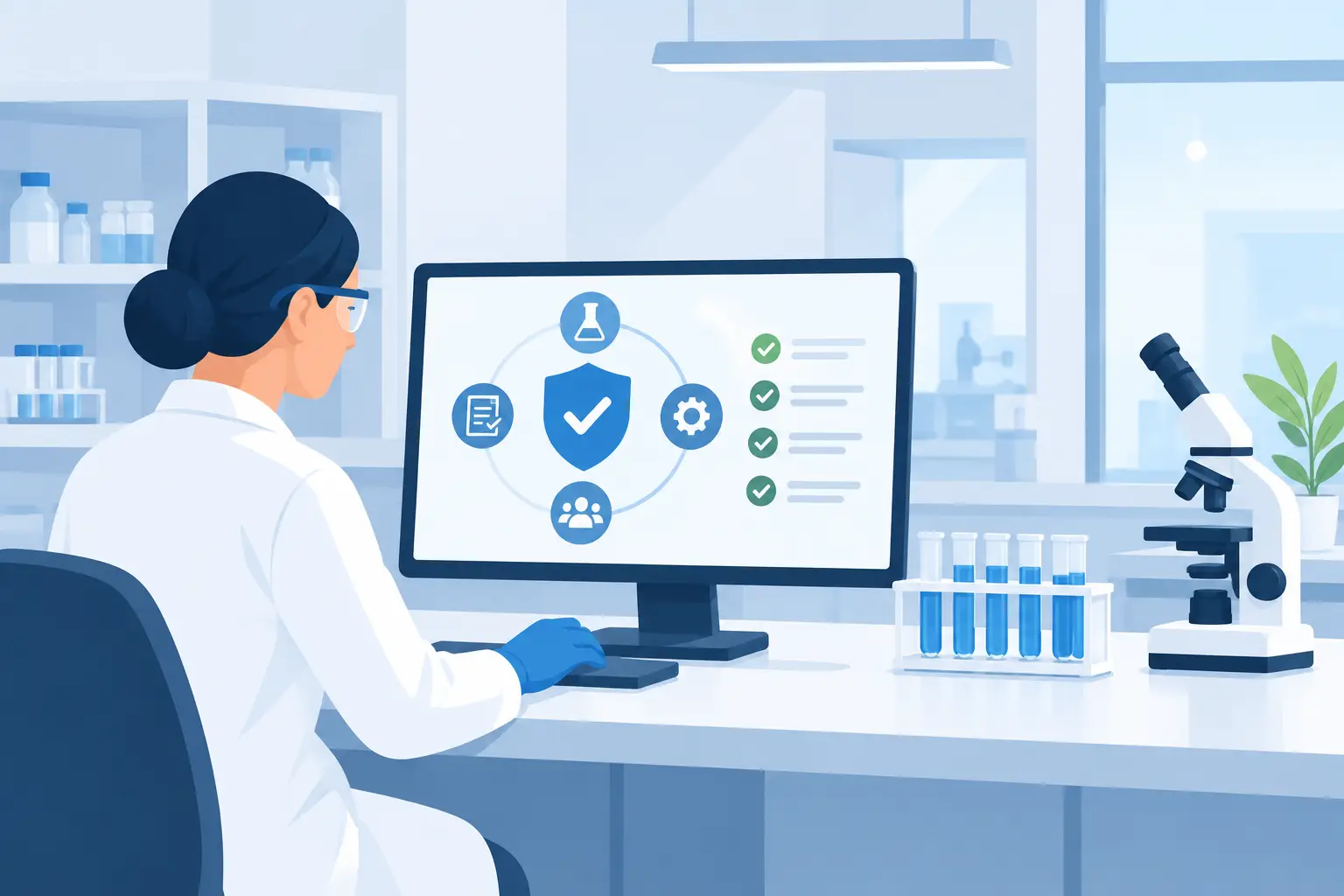
A compliance gap rarely begins with a failed audit. It usually starts with a sample location recorded in a spreadsheet, a reagent lot written on a bench sheet, or an instrument log that cannot be connected to the experiment it supported. The best systems for lab compliance address these routine breaks in traceability before they become quality events, delayed releases, or irreproducible results.
For regulated and quality-conscious laboratories, compliance software is not simply a document repository. It must establish a controlled system of record for samples, methods, materials, equipment, results, and user actions. The right system should make compliant work the normal path for scientists and technicians, rather than adding a separate administrative task after the work is complete.
What Lab Compliance Systems Must Control
Laboratory compliance requirements differ across research, clinical, pharmaceutical, industrial, and service environments. A GLP, GMP, CLIA, ISO 17025, ISO 15189, or 21 CFR Part 11 environment will not configure a system in exactly the same way. Still, the underlying operational controls are closely related: laboratories need attributable records, complete history, controlled access, reliable data retention, and evidence that defined processes were followed.
A useful compliance system connects these controls to daily laboratory activity. When a technician receives a specimen, the record should capture its identifier, source, receipt date, condition, storage position, and chain of custody. When the specimen is aliquoted, analyzed, transferred, or disposed of, each event should extend that same record. This continuity is more valuable than storing multiple static files in separate folders.
The same principle applies to materials and equipment. A test result may be difficult to defend if the laboratory cannot demonstrate which reagent lot was used, whether that lot was within expiry, which instrument generated the data, and whether the instrument was calibrated and available for use. Compliance depends on relationships between records, not merely on the existence of records.
Best Systems for Lab Compliance: Core Capabilities
Configurable sample and workflow traceability
A LIMS should support unique identifiers, barcode labels, sample hierarchies, storage tracking, status controls, and chain-of-custody events. It should follow a sample through the workflow without requiring users to recreate information in separate worksheets. For laboratories handling derivatives, batches, pools, or aliquots, parent-child relationships are essential. The system should preserve the lineage from original receipt through final result or disposition.
Workflow configuration matters as much as sample tracking. Laboratories should be able to define required fields, status transitions, review steps, and exception handling that reflect their actual procedures. A fixed workflow may be adequate for a narrow testing process, but it can force research and multi-department organizations into workarounds that reduce control.
Electronic records with audit trails
Electronic records need more than a timestamp. A meaningful audit trail records who created, changed, approved, or deleted information; when the action occurred; what changed; and, where required, why the change was made. The record must remain available for review without obscuring the original data.
Audit trails should apply to critical master data as well as transactional records. Changes to specifications, sample types, calculation templates, storage definitions, user roles, and controlled vocabulary can affect downstream work. If these changes occur without history or approval, the laboratory may lose the ability to explain how a reported result was produced.
Electronic signatures are also relevant when records require formal review or approval. The appropriate implementation depends on the laboratory's regulatory obligations, but the system should support defined signature meaning, authenticated user identity, and a permanent association between the signature and signed record.
Controlled documents and experimental context
A LIMS alone may not capture enough context for method development, research studies, investigations, or complex analytical work. An electronic lab notebook can provide controlled documentation for protocols, observations, calculations, attachments, and conclusions. When it is connected to sample, inventory, and instrument records, the ELN can preserve the scientific narrative alongside the operational data.
This connection reduces a common compliance weakness: a final report references data stored in one application, method notes stored in another, and reagent details stored on paper. A unified environment can associate experimental records with the materials, samples, instruments, and users involved in the work.
Inventory, lot, and expiry management
Expired, quarantined, or unqualified materials should not enter an active workflow unnoticed. Inventory management should track catalog information, lots, quantities, units, expiry dates, certificates, storage conditions, suppliers, and usage history. Where appropriate, the system should support status labels such as received, under review, released, rejected, or expired.
The practical test is whether a laboratory can answer a targeted question quickly: Which samples were processed with this reagent lot? Which tests used a material later found to be out of specification? Without lot-level consumption records, that investigation becomes a manual search across notebooks, worksheets, and instrument files.
Equipment qualification and instrument connectivity
Equipment records should document ownership, location, maintenance schedules, calibration status, service history, qualification documents, and availability. A system should prevent or flag use of an instrument that is overdue for calibration or under maintenance, based on the laboratory's defined rules.
Instrument integration can further reduce transcription risk by transferring data directly from connected instruments into controlled records. Integration is not automatically the right choice for every device. It requires interface maintenance, data mapping, and validation effort. For high-volume or high-risk workflows, however, reducing manual entry can improve both throughput and data integrity.
How to Evaluate a Compliance Platform
The best choice depends on the laboratory's processes, risk profile, and planned growth. A small research group may prioritize flexible experiment documentation and inventory control. A clinical or QC laboratory may place greater emphasis on reviewed results, controlled methods, electronic signatures, and formal validation documentation. A biobank may need deep specimen lineage, freezer mapping, consent-related fields, and long-term retention controls.
Start by mapping the records that must remain connected. Include sample receipt, testing steps, raw data references, reagent lots, instrument use, deviations, approvals, reports, and disposal. Then identify where the current process relies on paper, spreadsheets, shared drives, email approvals, or personal knowledge. These are not merely efficiency issues. They are points where data can be incomplete, overwritten, inaccessible, or difficult to reconstruct.
Assess configuration before customization. A configurable platform lets administrators define fields, workflows, templates, labels, permissions, and reports without modifying core software. Custom development may be justified for specialized calculations or interfaces, but excessive customization can increase upgrade, testing, and validation effort. The goal is to fit documented processes without creating a system that only its original implementer can maintain.
Permission design deserves particular scrutiny. Roles should reflect actual responsibilities, separating routine data entry from review, approval, administration, and quality functions where needed. Broad administrator access is convenient during deployment but can conflict with segregation-of-duties expectations. The system should also support account lifecycle management so access can be added, adjusted, and removed in a controlled manner.
Reporting is another selection criterion. Compliance teams need to retrieve complete records during audits, investigations, and periodic review. Scientists and managers need operational visibility into turnaround time, sample status, inventory levels, equipment due dates, and workflow bottlenecks. A system that captures data but cannot present it clearly creates a new layer of manual effort.
Validation Is a Process, Not a Product Feature
Software vendors can provide documentation, test evidence, release notes, and technical specifications. These materials are useful, but a vendor cannot validate a laboratory's specific configuration, procedures, intended use, and operating environment on its behalf. The laboratory remains responsible for establishing that its implemented system is fit for its intended use.
A risk-based validation approach typically defines requirements, evaluates system risks, documents configuration, tests critical functions, manages deviations, and approves the system for production use. The depth of effort should match the impact of the process. A system supporting GMP batch release requires more formal control than a tool used for preliminary research planning, although both benefit from disciplined implementation.
Change control must continue after go-live. New fields, workflow changes, interface updates, revised permissions, and software releases should be assessed for impact. Compliance failures often emerge after an initially well-controlled deployment is modified without adequate testing or documentation.
Building a Connected Compliance Environment
Many laboratories begin with separate tools for samples, notebooks, inventory, storage, instruments, and reporting. This can work temporarily, but every handoff creates a reconciliation burden. A connected platform reduces duplicate entry and makes it easier to trace relationships across the laboratory.
LabCollector, for example, combines LIMS, ELN, inventory, equipment, storage, barcode, automation, and reporting functions in a configurable environment. A modular structure can be especially useful when a laboratory needs to phase its implementation, starting with sample and inventory control before extending into electronic notebooks, instrument connectivity, or billing workflows.
The most effective compliance system is one that reflects how work actually moves through the laboratory. Define the records that matter, make required actions easy to perform at the bench, and preserve the evidence needed to explain every result months or years later. That is how compliance becomes part of laboratory operations rather than a scramble before inspection.
See LabCollector on Your Own Workflows
LIMS, ELN, test management, storage and instrument integration on one platform — start free, or have us walk you through it.
Learn more: LabCollector LIMS · Electronic Lab Notebook · Contact · About
 English
 French
 Spanish
 Portuguese
 Italian
 Polish
 German
 Dutch
 Danish
 Swedish
 Greek
 Norwegian
 Finnish
 Romanian
 Hungarian
 Czech
 Slovak
 Hebrew
 Arabic
 Japanese
 Korean
 Ukrainian
 Latvian
 Turkish
 Croatian
 Chinese (Simplified)
 Bulgarian