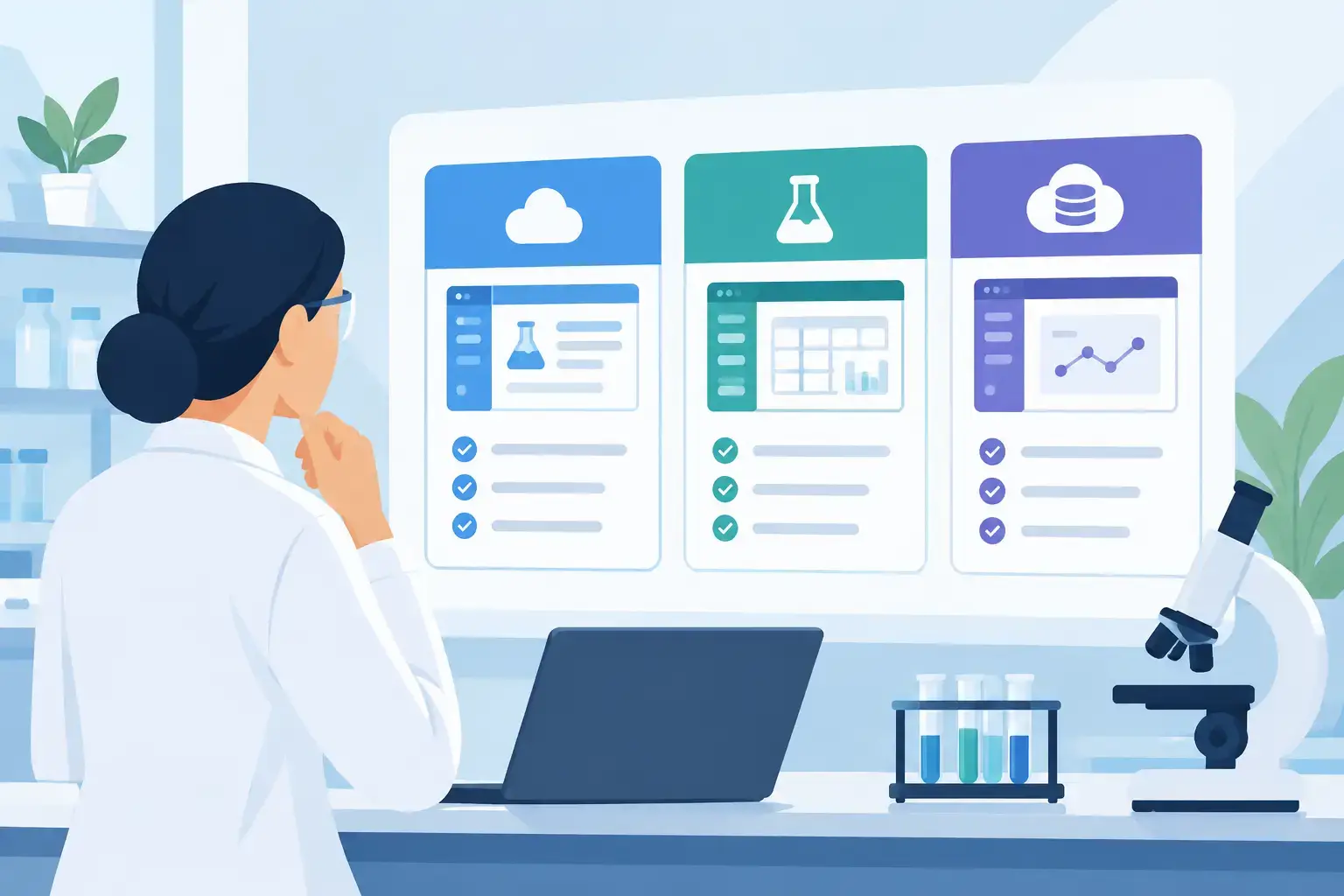
A laboratory rarely adopts an electronic lab notebook because paper notebooks alone are failing. The decision usually follows a more operational problem: experimental records are separated from sample data, reagent lots, instrument outputs, and storage locations. An effective ELN platform comparison guide must therefore look beyond note-taking features and assess how each system will control the complete scientific workflow.
For a principal investigator, the priority may be consistent experimental documentation and knowledge retention. For a lab manager, it may be reducing time spent locating samples, reconciling inventory, or preparing reports. Quality teams need attributable records, controlled templates, audit history, and appropriate review processes. The right platform depends on which of these requirements is most critical, and whether the ELN must operate as a standalone application or as part of a broader laboratory informatics environment.
An ELN Platform Comparison Guide for Requirements
Begin with the work your laboratory performs, not a vendor feature checklist. Document two or three representative workflows from start to finish. A molecular biology laboratory might follow a workflow from sample receipt through extraction, library preparation, sequencing, analysis, and long-term storage. A chemistry group may need to connect synthesis procedures, batch records, analytical results, hazardous materials, and equipment usage.
For each workflow, identify the data objects that must remain connected. These commonly include samples and aliquots, experimental protocols, reagents and lot numbers, instruments, raw data files, calculations, approvals, and final reports. If users must copy identifiers manually between the ELN and another system, the risk of transcription error and incomplete traceability remains.
This exercise also distinguishes a general-purpose digital notebook from an ELN designed for laboratory operations. Free-form pages are useful for exploratory work, but structured templates are necessary when a process must be repeated, reviewed, searched, or reported consistently. Laboratories with regulated activities may require additional controls, such as immutable audit trails, electronic signatures, role-based access, record retention policies, and documented validation support.
Define non-negotiable controls
A comparison is more useful when requirements are classified before product demonstrations begin. Separate features into three groups: controls required for data integrity, workflow functions required by active users, and capabilities that may be added as operations mature.
Data integrity requirements should address attribution, time-stamped changes, version history, permissions, and records that remain readable over time. Ask whether the system records who created, modified, reviewed, or approved an entry. Determine whether deleted information can be recovered or audited, and whether administrators can configure access without granting unnecessary authority.
Workflow requirements should be specific enough to test. Rather than asking whether a platform supports templates, ask whether a scientist can start an experiment from an approved template, select a registered sample by barcode, record a reagent lot, attach instrument output, and submit the record for review without leaving the system. Specific scenarios reveal configuration limits that broad demonstrations can hide.
Compare the ELN in Its Operating Context
An ELN can be highly capable while still creating fragmentation if it sits apart from sample management, inventory, and equipment records. The central question is whether the platform supports a connected system of record for the way your laboratory works.
Experimental documentation and templates
Assess how easily scientific teams can create and maintain templates for common procedures. Look for support for formatted text, tables, calculations, images, attachments, protocol references, and reusable components. Template governance matters as much as authoring convenience. A laboratory should be able to identify the approved version, control who can modify it, and preserve the version used for each completed experiment.
Consider flexibility carefully. Early-stage research may need adaptable notebook pages and rapid protocol changes. A high-throughput or quality-controlled environment may benefit more from required fields, predefined values, controlled units, and review routing. Many laboratories need both approaches for different work types.
Sample, inventory, and storage traceability
This is often the dividing line between a notebook application and a laboratory operations platform. Confirm whether the ELN can reference registered samples, parent-child relationships, aliquots, containers, and storage positions. The platform should preserve identifiers across experiments without forcing users to re-enter sample details.
Reagent tracking requires similar discipline. When experimental results depend on a specific antibody, kit, chemical, or media lot, the record should connect to the item, lot, expiration date, quantity, and supplier information where applicable. Barcode-supported workflows can reduce manual entry at the bench, but only if labels, scanners, and inventory records are part of the operating model.
Instruments, files, and automation
Instrument integration is not one feature. It can range from attaching exported PDF files to importing structured result files, capturing metadata automatically, or connecting directly with instruments and automation systems. Ask what integration methods are available and who is responsible for building and maintaining them.
A useful technical review examines file formats, APIs, import tools, automated data capture, and the handling of large datasets. Also establish whether raw data remains in the instrument data repository while the ELN stores metadata and a controlled reference, or whether the platform must retain both. The appropriate architecture depends on data volume, retention policy, access needs, and regulatory expectations.
Search, reporting, and reuse of knowledge
A notebook is only valuable after the experiment is complete if teams can retrieve its contents. Compare full-text search, structured field search, saved queries, reporting tools, and export options. Search should allow a scientist to find experiments by sample identifier, project, protocol, date range, author, reagent lot, or instrument, rather than relying solely on page titles.
Reporting needs vary by role. Lab managers may need inventory consumption and equipment utilization. Project leaders may need experiment status and sample throughput. Quality personnel may need review status, audit information, and deviations. A platform with configurable reports is useful, but evaluate whether reports can be produced by authorized lab staff or require vendor involvement for every change.
Test Administration, Security, and Scalability
A strong user experience cannot compensate for weak administrative control. During an ELN evaluation, involve the technical administrator early. They should review user provisioning, authentication options, groups and roles, permissions, archival procedures, backup practices, and data export capabilities.
Cloud-hosted and self-hosted deployments present different trade-offs. A cloud service can reduce local infrastructure responsibilities and simplify access across sites. A self-hosted deployment may be preferred where institutional security policies, network architecture, or data residency requirements dictate more direct control. The relevant question is not which model is universally better, but which responsibility model your organization can support.
Scalability also includes configuration governance. As projects, teams, and templates increase, a laboratory needs naming conventions, ownership rules, permission standards, and change-control practices. Without them, an initially organized system can accumulate duplicate templates, inconsistent fields, and unclear records.
Compare Cost Beyond the License
License pricing is only one component of total cost. Implementation effort may include workflow mapping, data migration, template configuration, integrations, validation activities, training, and ongoing administration. A lower initial price may become expensive if substantial custom development is required to connect the ELN to core laboratory records.
Ask vendors to explain what is available through configuration, what requires professional services, and what requires custom code. Request a realistic implementation plan based on your workflows, including data migration assumptions, acceptance criteria, training responsibilities, and support after go-live.
Modular platforms can be particularly relevant when an organization needs an ELN now but expects to add LIMS, inventory, storage, ordering, equipment, or reporting capabilities later. For example, LabCollector brings ELN functions together with modules for samples, inventory, equipment, automation, and barcoding. The operational benefit is not simply having more functions in one interface. It is maintaining related laboratory data in a controlled environment where records can be connected and traced.
Use a Scenario-Based Evaluation
Do not select an ELN based on a generic demonstration. Give each shortlisted vendor the same scripted scenarios and ask them to show the workflow using realistic data. Include an experiment that consumes registered samples and reagent lots, requires instrument output, routes for review, and must be located later through search and reporting.
Evaluate the results with scientists, laboratory operations staff, quality representatives, and IT. Score each scenario for usability, traceability, configuration effort, administrative burden, and fit with existing systems. A scoring model does not replace judgment, but it prevents the decision from being driven solely by the most polished demonstration.
The best ELN selection is the one that makes the correct scientific and operational process easier to follow every day. When records, samples, materials, instruments, and approvals remain connected, the laboratory gains more than digital notebooks: it gains a dependable foundation for reproducible work.
See LabCollector on Your Own Workflows
LIMS, ELN, test management, storage and instrument integration on one platform — start free, or have us walk you through it.
Learn more: LabCollector LIMS · Electronic Lab Notebook · Contact · About
 English
 French
 Spanish
 Portuguese
 Italian
 Polish
 German
 Dutch
 Danish
 Swedish
 Greek
 Norwegian
 Finnish
 Romanian
 Hungarian
 Czech
 Slovak
 Hebrew
 Arabic
 Japanese
 Korean
 Ukrainian
 Latvian
 Turkish
 Croatian
 Chinese (Simplified)
 Bulgarian