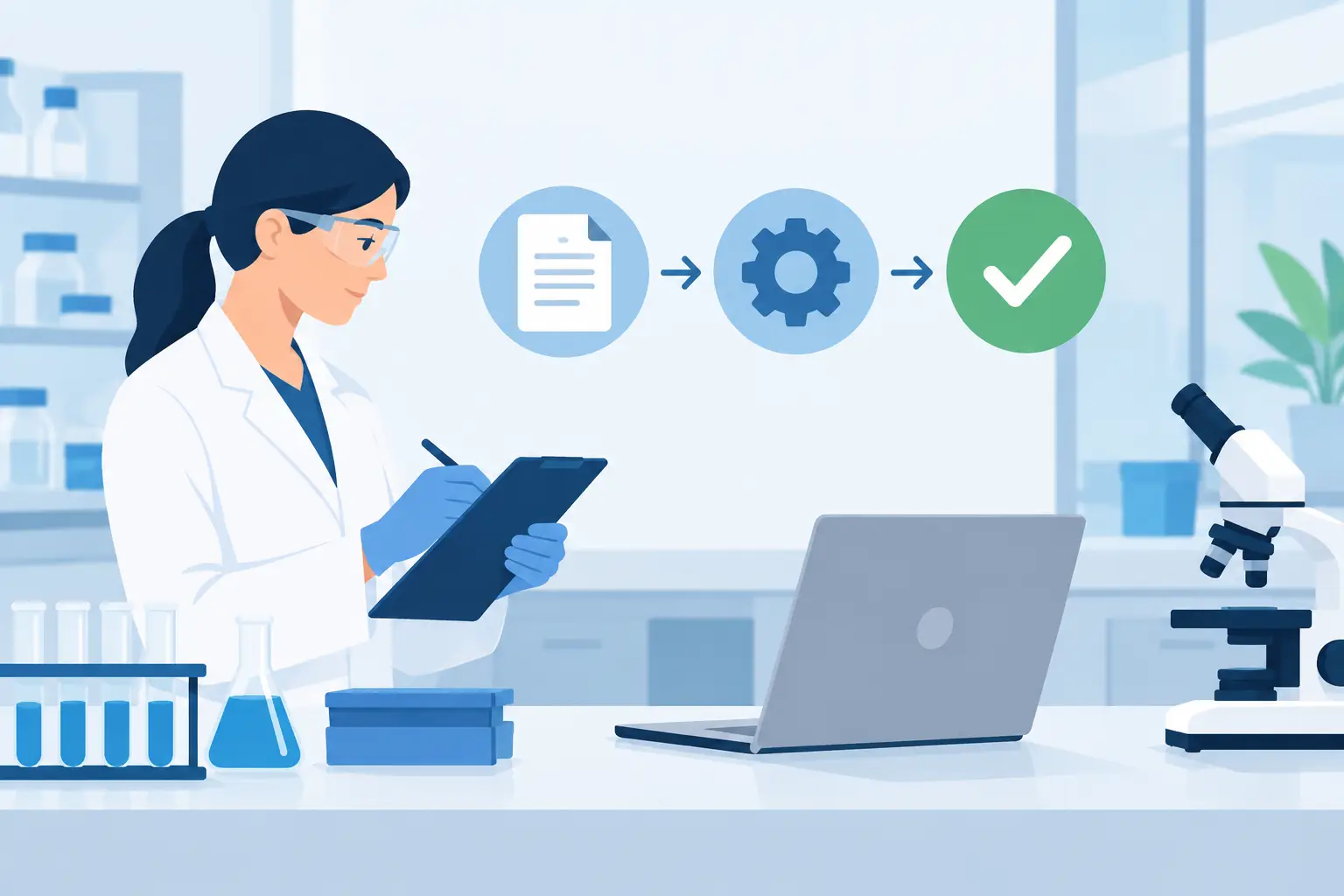
A reagent substitution that seems minor can alter an assay's performance, affect comparability with historical results, and create a gap during an audit if the decision was only discussed by email. A guide to laboratory change control should therefore start with a practical principle: changes are not administrative events. They are controlled decisions that protect the validity, traceability, and repeatability of laboratory work.
For research, clinical, quality control, and regulated laboratories, change control provides a documented method for evaluating what will change, why it is needed, who is affected, what risks it introduces, and how the laboratory will verify success. The level of formality should match the impact. Changing the location of a low-risk consumable does not require the same assessment as replacing a LIMS workflow, revising a validated analytical method, or connecting an instrument to a new data system.
What laboratory change control is designed to prevent
Laboratory operations rarely stand still. Teams introduce new instruments, revise sample workflows, qualify suppliers, update SOPs, change storage conditions, modify test methods, and configure new electronic records. Without a defined control process, these changes can be implemented inconsistently across shifts, sites, or teams.
The resulting problems are often discovered after the fact. Samples may be processed under different conditions without a clear record. Inventory records can become disconnected from approved materials. An instrument configuration may change without confirming its effect on calculations or data transfer. Personnel may follow an outdated procedure because the revised document was not effectively released and trained.
Change control creates a traceable decision path before implementation. It establishes the current state, proposed state, justification, impact assessment, approvals, implementation plan, verification evidence, and final closure. This record supports data integrity and gives laboratory management a reliable view of operational change over time.
Change control is not the same as a deviation or CAPA
These quality processes are related, but they answer different questions. A deviation documents an unplanned departure from an approved procedure or expected condition. A corrective and preventive action, or CAPA, addresses the underlying cause of a nonconformance and prevents recurrence.
Change control is prospective. It manages an intended modification before it becomes part of routine work. A CAPA may require a change control when its corrective action includes a procedure revision, equipment replacement, software configuration change, or method update. Keeping these records connected is useful, but combining them into one uncontrolled workflow can obscure the purpose and status of each activity.
A guide to laboratory change control: the core workflow
An effective workflow is structured enough to maintain accountability but practical enough that laboratory personnel use it consistently. The following stages work across many laboratory environments, with additional validation and regulatory review where required.
1. Define the proposed change and its business reason
Start with a specific description of the change. Avoid statements such as “update the sample process.” Instead, identify what will change, where it applies, and what will remain unchanged. For example, “replace manual sample accessioning spreadsheets with barcode-driven accessioning in the molecular diagnostics workflow” gives reviewers a usable starting point.
The request should also explain the reason. Common drivers include improved traceability, supplier discontinuation, capacity constraints, recurring errors, instrument end of life, regulatory requirements, or a need to standardize processes between laboratory locations. A clear rationale helps reviewers distinguish a necessary operational improvement from a change that adds complexity without measurable benefit.
2. Assess impact and risk before approval
Impact assessment is the center of laboratory change control. The question is not simply whether the change can be made. The laboratory must determine what could be affected and what evidence is needed before routine use.
Review the impact on samples, methods, reagents, equipment, personnel, documents, electronic records, reports, integrations, and downstream customers. For software-related changes, assess user roles, audit trails, data migration, interfaces, calculations, electronic signatures, and backup or recovery procedures. For physical workflow changes, consider chain of custody, storage capacity, environmental controls, contamination risk, and labeling practices.
Risk should be evaluated in terms of patient, product, scientific, compliance, and business impact. A risk-based approach prevents unnecessary validation work for low-impact changes while ensuring that high-impact modifications receive appropriate scrutiny. The assessment may require input from quality assurance, laboratory operations, IT, method owners, biosafety, and data governance teams.
3. Set required approvals and implementation controls
Approval should follow the impact assessment, not precede it. The approvers must have enough information to determine whether the proposed controls are adequate. Depending on the laboratory, this may include the laboratory director, quality unit, technical lead, validation representative, data privacy officer, or system administrator.
The implementation plan should identify ownership, target dates, prerequisites, and rollback actions. A rollback plan is particularly relevant for software configurations, instrument integrations, and process changes that could interrupt sample throughput. If the new process fails acceptance criteria, the laboratory needs a controlled path back to the approved state without losing records or introducing uncertainty about which workflow was used.
4. Execute, test, and document evidence
Implementation is not complete when a configuration is changed or a revised SOP is published. The laboratory must demonstrate that the change performs as intended. Evidence may include installation records, qualification results, method comparison data, user acceptance testing, training completion, revised labels, inventory disposition, or reconciliation of migrated records.
Acceptance criteria should be established before testing. For example, a new barcode workflow may require every received sample to generate a unique identifier, print a readable label, retain an accession audit trail, and transfer the correct metadata into the LIMS. Defining these criteria early avoids subjective closure decisions.
For regulated or validated systems, determine whether the change requires formal validation, partial regression testing, or documented verification. The answer depends on the system's intended use, the configured function, and the potential effect on data quality. A display-only dashboard adjustment may require less evidence than a modification to calculations, report templates, or sample status logic.
5. Train users and control the effective date
A technically correct change can still fail operationally if users are not prepared. Training should be role-specific and completed before the effective date. Personnel need to understand not only the new steps but also when the old process is retired, how exceptions will be handled, and where controlled documentation is located.
For changes with a broad operational effect, consider a phased release or pilot group. This approach can reduce disruption and reveal practical issues before full deployment. It is not always appropriate, however. A compliance-driven procedure update may need a single effective date to avoid having multiple approved practices in use simultaneously.
6. Verify effectiveness and close the record
After implementation, confirm that the expected outcome was achieved. Effectiveness checks should address the original reason for the change. If a reagent supplier was changed because of lot-to-lot variability, review relevant performance and quality data. If an electronic workflow was introduced to reduce transcription errors, compare error rates or reconciliation findings after adoption.
Close the record only when approvals, evidence, training, document updates, and follow-up actions are complete. Open actions should not disappear into email threads or informal task lists. If a follow-up item cannot be completed on time, document the reason, assess the impact, and extend the change control through a visible approval process.
Building change control into the laboratory system of record
Spreadsheets and shared folders can support simple change logs, but they often make it difficult to maintain version control, approvals, related records, and a complete audit history. As the laboratory grows, change control is more effective when it is connected to the systems that hold affected data and workflows.
A centralized platform can associate a change request with the relevant SOP, instrument, reagent, sample workflow, training record, or validation evidence. This reduces duplicate entry and makes the impact of a proposed change easier to evaluate. It also supports controlled permissions, timestamped approvals, status tracking, and reporting on overdue actions.
Within a configurable laboratory informatics environment such as LabCollector, teams can structure change records around their own quality processes while maintaining connections to inventory, equipment, documents, samples, and operational data. The objective is not to force every laboratory into the same template. It is to ensure that the required information is captured consistently and remains available for review.
Common weaknesses that undermine change control
The most common failure is treating change control as a form to complete after the work is done. Retrospective documentation may describe the result, but it cannot show that risks were evaluated and approvals were granted before implementation.
Another weakness is vague impact assessment. If the record says “no impact expected” without identifying the systems, records, or procedures reviewed, it provides little assurance. Reviewers should be able to see why a change was categorized as low, medium, or high risk.
Laboratories also struggle when they close records based on implementation alone. Installation, configuration, and training are activities. Effectiveness is evidence that the change solved the stated problem without creating an unacceptable new risk.
A disciplined change control process gives laboratories room to improve without losing control of the conditions that make their results reliable. When each significant change has an owner, a reason, an assessed impact, and verifiable evidence, the laboratory can move faster with a clearer record of why its processes evolved.
See LabCollector on Your Own Workflows
LIMS, ELN, test management, storage and instrument integration on one platform — start free, or have us walk you through it.
Learn more: LabCollector LIMS · Electronic Lab Notebook · Contact · About
 English
 French
 Spanish
 Portuguese
 Italian
 Polish
 German
 Dutch
 Danish
 Swedish
 Greek
 Norwegian
 Finnish
 Romanian
 Hungarian
 Czech
 Slovak
 Hebrew
 Arabic
 Japanese
 Korean
 Ukrainian
 Latvian
 Turkish
 Croatian
 Chinese (Simplified)
 Bulgarian