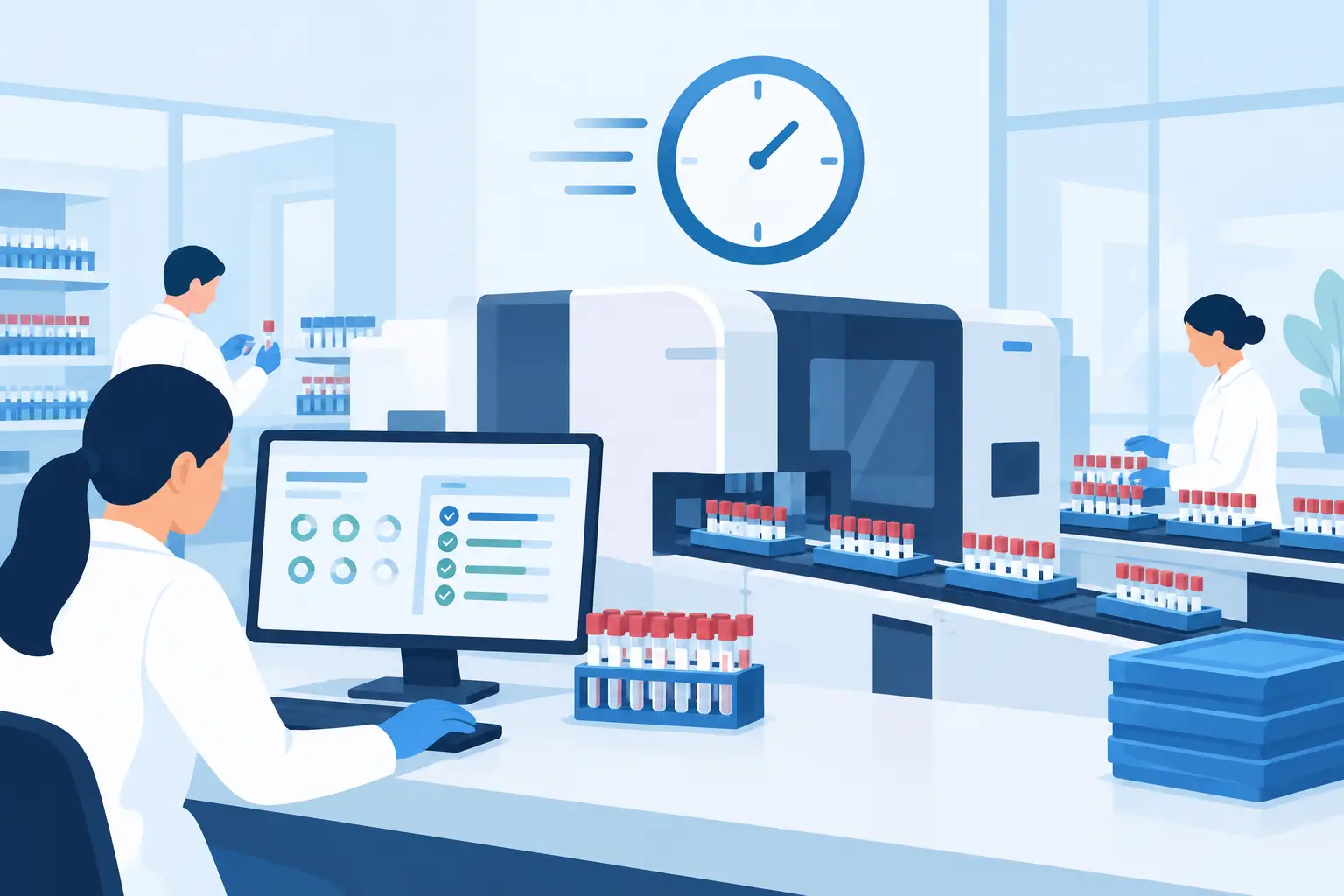
A specimen can arrive on time and still produce a late result. The delay may occur at accessioning, during batch formation, while an instrument waits for maintenance, or when a reviewer must resolve incomplete data. How labs manage test turnaround is therefore not a single scheduling decision. It is an operating model that connects specimen receipt, analytical work, quality review, reporting, and the exceptions that occur between each stage.
For clinical, research, and service laboratories, turnaround time affects more than customer expectations. It influences sample stability, study timelines, staffing decisions, instrument utilization, and the laboratory's ability to maintain documented control over its work. Reliable turnaround depends on visibility into the full workflow, not simply pressure to process samples faster.
Turnaround time starts with a defined clock
A laboratory cannot improve turnaround time until it defines what the measurement means. Some organizations measure from specimen collection to final report. Others measure from receipt at the laboratory to result release, or from work order approval to completion. These definitions are not interchangeable, especially when collection and transportation are managed by external sites.
The operational clock should be tied to the service being delivered and applied consistently across sample types, priorities, and testing locations. A routine chemistry assay, a STAT clinical test, and a multi-stage sequencing workflow need different service-level expectations. Treating them as one metric can hide delays that matter to clinicians, project managers, or clients.
Labs also distinguish total turnaround from internal processing time. Total turnaround captures the experience of the requester. Internal processing time identifies delays under laboratory control, such as queue time, repeat testing, review, and approval. Both measures are useful, but they answer different management questions.
How labs manage test turnaround through workflow control
Laboratories manage turnaround most effectively when every handoff has a defined status, owner, and timestamp. A sample should not disappear into a generic "in process" state for hours or days. The system should show whether it is awaiting accessioning, preparation, extraction, analysis, quality control review, technical review, or final release.
Start with accurate accessioning and triage
The first workflow decision often determines the rest of the timeline. At receipt, staff verify sample identity, container type, volume, condition, collection time, requested tests, and any special handling requirements. Barcoding associates the physical specimen with its digital record and reduces transcription errors during downstream processing.
Triage rules then route work based on priority, stability window, test methodology, and required resources. A high-priority specimen may move directly into a dedicated queue, while a routine specimen is held for an efficient batch. The appropriate choice depends on the assay. Running every test immediately may reduce queue time but increase reagent use, instrument changeovers, and operator workload.
Standardize the path from sample to result
A documented workflow reduces variation between operators and shifts. Standard operating procedures define required checks, decision points, acceptance criteria, and escalation paths. In a LIMS, these steps can be represented as workflow states, required fields, controlled status changes, and role-based approvals.
Standardization does not mean every sample follows an identical route. It means exceptions follow a controlled route. For example, insufficient volume, failed controls, contamination concerns, or missing requisition data should trigger an exception status with a clear next action. Staff should not rely on email chains or handwritten notes to determine what happened and who must respond.
Connect instruments and analytical data
Manual result entry creates delay and increases the chance of transcription errors. Instrument integration can transfer analytical data into the laboratory record, associate runs with samples, and flag values that require review. This is particularly valuable in high-volume environments where a single batch may contain dozens or hundreds of specimens.
Integration must be configured around the laboratory's validation and review process. Not every result should be released automatically. Reference ranges, quality control outcomes, delta checks, calculation rules, and reviewer requirements may all determine whether a result can move forward. The goal is not automatic release at any cost. It is to eliminate unnecessary manual handling while preserving scientific and clinical oversight.
Find the queue, not just the slow test
The assay with the longest analytical runtime is not always the main turnaround problem. Many laboratories lose more time in queues before and after testing: specimens awaiting sorting, batches awaiting sufficient volume, runs awaiting instrument availability, or completed data awaiting review.
Queue analysis requires timestamps at each material handoff. When a laboratory compares median and percentile times by workflow step, it can identify whether delays are consistent or concentrated in a smaller group of cases. Median turnaround shows typical performance. The 90th or 95th percentile exposes the delayed specimens that can affect service commitments and create escalation work.
Useful operational measures include receipt-to-accession time, accession-to-test-start time, test-start-to-result time, result-to-review time, and review-to-release time. Laboratories should also track repeat rate, rejected specimen rate, instrument downtime, and the number of samples in each queue. A favorable average can conceal a growing backlog if a small number of urgent cases are completed quickly while routine work accumulates.
Dashboards are most effective when they support action. A supervisor needs to see which queue is approaching its service target, which instrument is unavailable, and which samples have been waiting beyond a defined threshold. Historical reporting supports staffing and capacity planning; real-time operational views support intervention during the shift.
Balance speed with quality and compliance
Faster turnaround is valuable only when results remain accurate, traceable, and defensible. Skipping verification steps, overriding quality control failures, or releasing incomplete records may improve a dashboard metric temporarily while increasing corrective actions and compliance risk.
A controlled workflow preserves the connection between the specimen, method, reagent lot, instrument, operator, raw data, calculations, quality controls, and final report. For regulated laboratories, this traceability supports audits, investigations, and result amendments. For research laboratories, it supports reproducibility and confidence in experimental data.
The practical question is which checks prevent meaningful risk and which are artifacts of paper-based or disconnected processes. A digital workflow can require essential approvals while removing duplicate data entry, manual label transcription, and repeated searches across spreadsheets. That distinction is where turnaround improvement becomes sustainable.
Use a connected laboratory system as the control layer
Fragmented tools make it difficult to manage timing because the laboratory record is spread across paper logs, instrument software, spreadsheets, email, and separate inventory files. A connected LIMS and ELN environment provides a shared operational record for samples, test requests, experimental documentation, equipment, reagents, and results.
With configurable workflows, a laboratory can apply test-specific statuses, assign worklists, enforce required metadata, and record each transition automatically. Barcode scanning supports specimen movement and chain of custody. Inventory controls can prevent work from starting when a required reagent is expired, unavailable, or not assigned to an approved lot. Equipment records can identify whether an instrument is qualified, maintained, and available for the method.
LabCollector can serve as this central control layer by bringing sample tracking, workflow management, inventory, instrument records, automation, and reporting into one configurable environment. The value is not merely having more data in one place. It is enabling staff to act on current status without reconstructing the workflow from disconnected systems.
Plan capacity around variability and exceptions
Turnaround management is a capacity discipline as much as a software discipline. Demand fluctuates by day, project phase, collection schedule, season, and client mix. Laboratories need enough flexibility to absorb peaks without maintaining excessive idle capacity during normal volume.
Capacity planning should account for the true constraint. It may be a specialized instrument, a trained reviewer, a clean room, a reagent supply, or a particular preparation step. Adding personnel to a non-constrained stage will not resolve the bottleneck. Likewise, extending hours may help during a temporary surge but can create quality and retention issues if used as a permanent substitute for workflow design.
Exception trends deserve equal attention. A recurring incomplete requisition, sample rejection, failed run, or review hold is not simply an isolated delay. It is evidence that a process upstream needs correction. Categorizing exceptions and assigning corrective actions reduces recurring rework, which is often one of the largest hidden contributors to extended turnaround.
The most reliable turnaround improvements come from making work visible before it becomes late. When laboratories can see each sample's status, queue position, dependencies, and exception history, they can intervene with control rather than urgency.
See LabCollector on Your Own Workflows
LIMS, ELN, test management, storage and instrument integration on one platform — start free, or have us walk you through it.
Learn more: LabCollector LIMS · Electronic Lab Notebook · Contact · About
 English
 French
 Spanish
 Portuguese
 Italian
 Polish
 German
 Dutch
 Danish
 Swedish
 Greek
 Norwegian
 Finnish
 Romanian
 Hungarian
 Czech
 Slovak
 Hebrew
 Arabic
 Japanese
 Korean
 Ukrainian
 Latvian
 Turkish
 Croatian
 Chinese (Simplified)
 Bulgarian