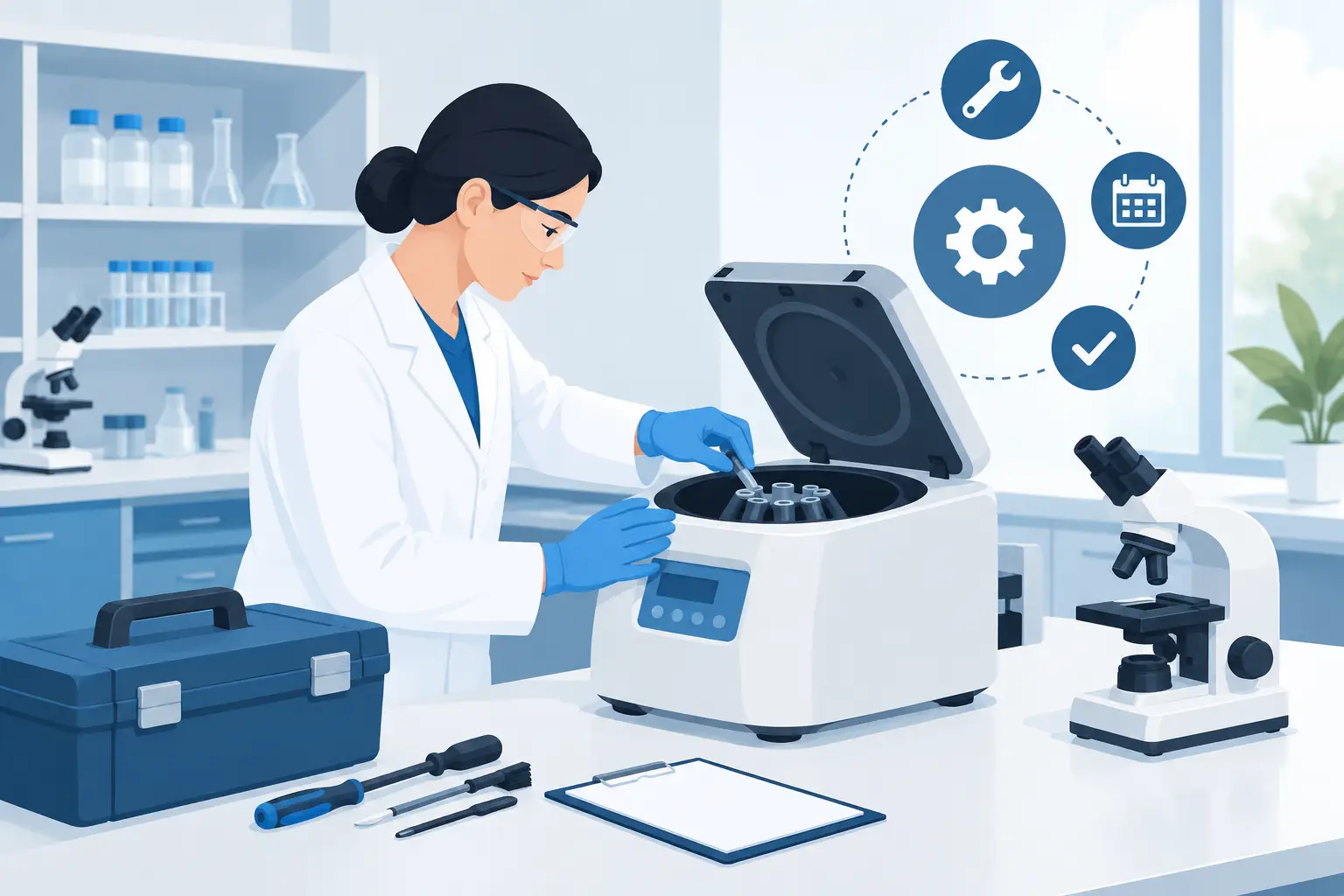
A failed centrifuge before a time-sensitive extraction, an incubator that drifts outside its validated temperature range, or a pipette with an overdue calibration can interrupt far more than one experiment. These events affect sample integrity, turnaround time, regulatory readiness, and confidence in reported results. Knowing how to manage equipment maintenance means building a controlled process that makes each asset's condition, history, ownership, and upcoming obligations visible before a failure creates a laboratory-wide problem.
Equipment maintenance is not only an engineering task. In a laboratory, it is part of the quality system. The maintenance process must connect instruments to the methods, samples, users, service records, and compliance requirements that depend on them. A practical program balances preventive work with available staff capacity and keeps critical instruments ready without creating unnecessary administrative burden.
Start With a Complete Equipment Inventory
Maintenance cannot be controlled if the laboratory does not have an authoritative equipment register. Spreadsheet lists often become unreliable because serial numbers, locations, service documents, and ownership details are maintained in different files or not updated after an instrument moves.
Create one record for every maintainable asset, including analytical instruments, environmental monitoring devices, cold storage units, balances, centrifuges, safety equipment, and supporting infrastructure. Each record should have a unique asset ID and, where practical, a barcode or QR code that staff can scan at the point of use.
The record should identify the manufacturer, model, serial number, purchase date, current location, department, asset owner, and operational status. It should also distinguish whether the equipment is active, under repair, retired, quarantined, or awaiting qualification. This status matters: a failed instrument should not remain selectable in a scheduling or sample-processing workflow.
For regulated or quality-sensitive work, attach the documents that establish the asset's approved use. These may include installation qualification, operational qualification, performance qualification, validation protocols, vendor manuals, service contracts, and standard operating procedures. A centralized record reduces the risk that a technician relies on an outdated procedure stored in a local folder.
How to Manage Equipment Maintenance by Risk
Not every asset needs the same maintenance frequency or the same level of documentation. A laboratory should set priorities based on risk rather than treating every device as equally critical.
Consider the consequences if the equipment fails or produces inaccurate data. A -80 C freezer containing irreplaceable clinical specimens requires a different control strategy than a noncritical vortex mixer. Likewise, an HPLC system used for release testing may need more formal calibration and service evidence than an instrument used only for preliminary method development.
A useful risk assessment considers four practical factors:
- The effect of failure on sample integrity, patient results, product quality, or safety
- The likelihood of failure based on age, condition, utilization, and service history
- The availability of a qualified backup instrument or an alternative workflow
- The effort required to detect a malfunction before it affects results
Use this assessment to classify equipment as critical, important, or routine. Critical assets generally require documented preventive maintenance, defined acceptance criteria, alarm response procedures, and tighter review of overdue work. Routine assets may be managed through simpler inspection schedules. The objective is not to generate more tasks. It is to apply control where a missed task has meaningful scientific or operational consequences.
Build a Preventive Maintenance Schedule
Reactive maintenance is expensive because it happens at the least convenient time. A preventive maintenance program converts manufacturer recommendations, internal procedures, and observed equipment behavior into scheduled work orders.
For each asset, define the maintenance activity, frequency, responsible role, estimated downtime, required parts, and completion criteria. For example, a biosafety cabinet may need routine certification and filter-related service; a balance may require daily verification, periodic calibration, and cleaning; an autoclave may require cycle review, chamber inspection, and scheduled qualification. The correct interval depends on the instrument's intended use, manufacturer guidance, utilization level, environmental conditions, and applicable regulations.
Avoid setting a calendar interval without considering use. A heavily used pipette fleet may need more frequent calibration than a set used occasionally for noncritical transfers. Conversely, reducing service frequency merely to lower costs can create greater expense through invalidated work, repeat testing, or unplanned downtime.
Maintenance schedules should generate advance notifications rather than alerts only on the due date. This gives equipment owners time to coordinate vendor visits, reserve backup capacity, and avoid scheduling sensitive work during planned downtime. Escalate overdue tasks according to asset criticality, and document the disposition when a task cannot be completed on time.
Separate Maintenance, Calibration, and Qualification
These activities are related, but they are not interchangeable. Treating them as the same process can leave gaps in the equipment record.
Maintenance keeps an asset functioning as intended. It may include cleaning, lubrication, replacement of worn components, software updates, or inspection. Calibration compares instrument performance against a traceable standard and documents whether measurements meet specified tolerances. Qualification demonstrates that the equipment is installed correctly and performs consistently for its intended use.
A repair can also trigger calibration or requalification. Replacing a detector, updating control software, relocating an instrument, or completing a major repair may change the asset's qualified state. The maintenance workflow should therefore include a decision point: can the equipment return to service immediately, or does it require verification, calibration, quality review, or requalification first?
Define acceptance criteria before work begins. A service report stating that work was completed is not sufficient evidence that the instrument is fit for laboratory use. Record the test performed, result, tolerances, reference standards, service provider, date, and reviewer approval where required. If the asset fails acceptance criteria, change its status to prevent use until the issue is resolved and assessed.
Make Work Orders Traceable and Usable
A maintenance plan fails when technicians must search through emails, paper binders, and vendor portals to understand what was done. Each service event should be captured as a work order linked to the specific asset record.
The work order should show why the work was initiated, whether it was scheduled or corrective, who performed it, which procedure was followed, what parts were used, and the final outcome. Attach service certificates, calibration reports, photographs where useful, and deviation records. If the failure affected active studies, batches, or samples, document the impact assessment and any follow-up actions.
This history supports better decisions over time. Repeated temperature alarms on one freezer, recurring pump failures on an analyzer, or frequent repairs to an aging centrifuge may indicate that replacement is more economical than continued service. Maintenance data can also reveal patterns tied to a location, operator practice, power quality, or environmental conditions.
A configurable laboratory management platform such as LabCollector can centralize asset records, barcodes, scheduled actions, supporting documents, and audit-ready histories alongside related laboratory data. The value is not simply digitizing a logbook. It is making equipment status part of the operational workflow so staff can act on current information.
Assign Clear Ownership and Control Access
Equipment records need accountable owners. Assign an asset owner who understands the instrument's use and a maintenance coordinator who monitors schedule completion, vendor interactions, and documentation. In smaller laboratories, one person may hold both roles. In larger organizations, responsibilities may be distributed among laboratory operations, quality assurance, metrology, and facilities teams.
Access controls should match those responsibilities. Users may need to report faults or view equipment status, while only authorized staff should close work orders, alter service intervals, approve calibration results, or retire an asset. An audit trail should capture changes to key fields, including status, due dates, acceptance decisions, and attached records.
Training is another control point. Link authorized users to the current SOPs and training requirements for complex or high-risk equipment. If an instrument requires a specific qualification before operation, the laboratory should be able to verify that authorization rather than relying on informal knowledge.
Use Maintenance Data to Plan, Not Just Document
A maintenance program should produce management information, not merely a record of completed tasks. Review overdue maintenance rates, mean time between failures, repair frequency, calibration pass rates, downtime, service costs, and vendor response performance. For critical assets, track whether backup capacity performed as expected during outages.
These metrics help laboratories decide where to invest. A low-cost instrument with repeated failures may consume disproportionate staff time. A vendor contract may appear expensive until it is compared with emergency repair costs and lost instrument availability. The right choice depends on the asset's criticality, age, replacement lead time, and effect on laboratory throughput.
Treat equipment maintenance as a living operational process. When methods change, instruments move, utilization increases, or a new quality requirement applies, review the maintenance strategy. The strongest programs make the next required action clear while preserving enough history to explain why each asset can be trusted for its intended work.
See LabCollector on Your Own Workflows
LIMS, ELN, test management, storage and instrument integration on one platform — start free, or have us walk you through it.
Learn more: LabCollector LIMS · Electronic Lab Notebook · Contact · About
 English
 French
 Spanish
 Portuguese
 Italian
 Polish
 German
 Dutch
 Danish
 Swedish
 Greek
 Norwegian
 Finnish
 Romanian
 Hungarian
 Czech
 Slovak
 Hebrew
 Arabic
 Japanese
 Korean
 Ukrainian
 Latvian
 Turkish
 Croatian
 Chinese (Simplified)
 Bulgarian