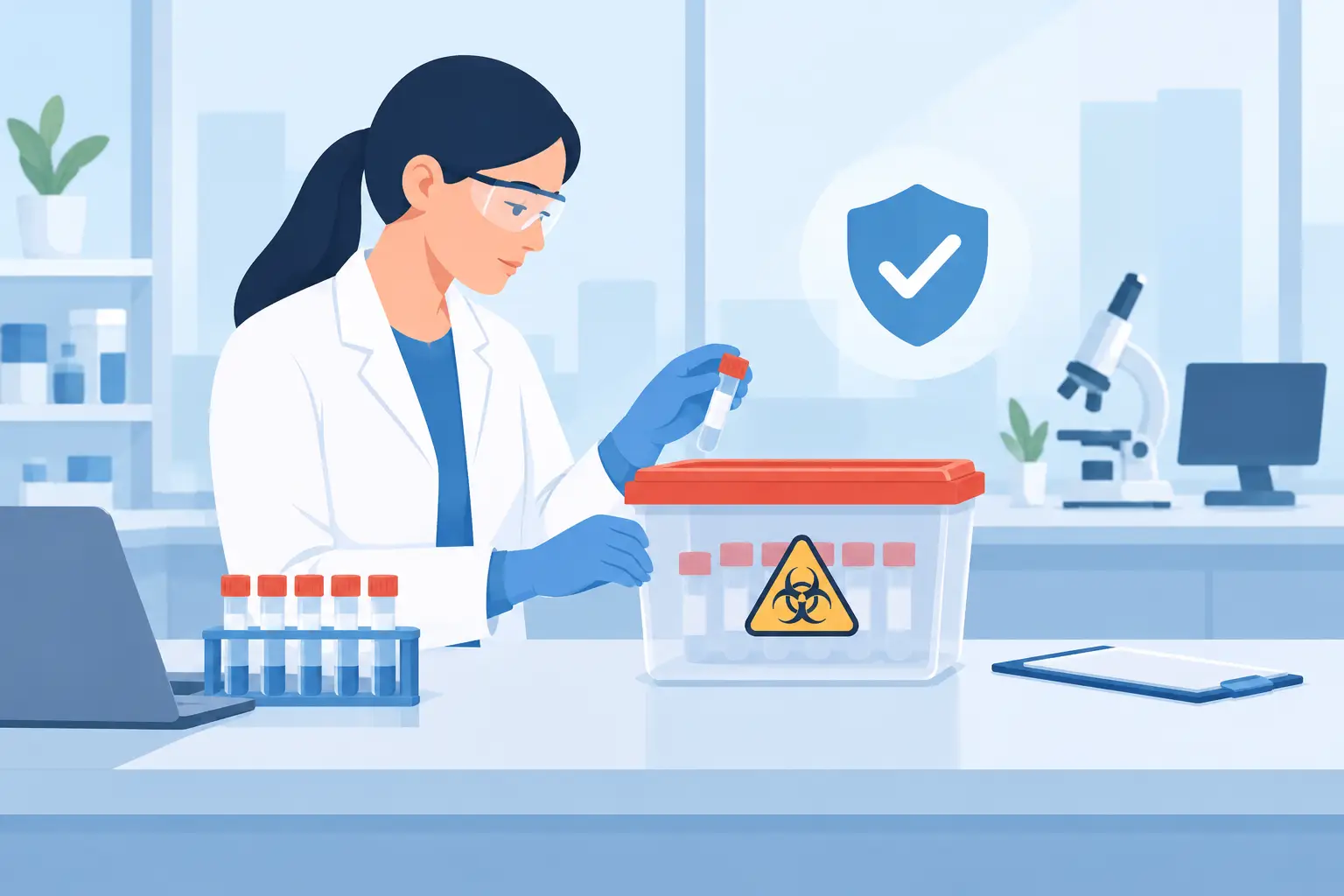
A quarantine label is not a complete control mechanism. When a sample is awaiting test results, quality review, identity confirmation, or a disposition decision, the laboratory must be able to answer four questions immediately: where is it, why is it quarantined, who owns the next action, and what prevents unauthorized use? To manage quarantine samples effectively, those answers must be available from the sample record rather than reconstructed from spreadsheets, emails, freezer notes, and verbal handoffs.
Quarantine management is particularly consequential in regulated clinical, pharmaceutical, biobank, and service environments, but the same discipline improves reproducibility in research laboratories. A mislabeled tube, a released sample with incomplete results, or an unrecorded transfer can affect downstream experiments, product decisions, and audit findings. The objective is not to create more administrative work. It is to establish a controlled workflow that keeps questionable or pending material visible, segregated, and traceable until an authorized decision is made.
Define what quarantine means in your laboratory
Quarantine is often treated as a single status, yet laboratories place material in quarantine for different operational reasons. Incoming specimens may await accessioning or identity verification. Reagents and raw materials may await certificate review or incoming quality control. Clinical or research samples may await test completion, deviation assessment, or confirmation of chain of custody. Each reason can require different permissions, review steps, and release criteria.
Start by defining a clear status model. At minimum, distinguish active, quarantined, released, rejected, consumed, and disposed material. A single generic “hold” status can work for a small laboratory, but it becomes difficult to report on aging inventory or identify bottlenecks as volume grows. Consider recording a quarantine reason as a controlled field, such as pending QC, identity discrepancy, temperature excursion, incomplete documentation, or investigation open.
The status model should also define allowed transitions. For example, a sample can move from received to quarantined after accessioning, then to released only after required analytical results and quality review are complete. It should not be possible for a general user to change a quarantined sample directly to available inventory without approval. These rules turn status labels into workflow controls.
Build a complete quarantine sample record
Every quarantined item needs a unique identity and a record that remains intact throughout its lifecycle. Barcoding is central to this process because it reduces transcription errors at receipt, storage, transfer, testing, and disposition. The barcode should resolve to a record containing the specimen or material identifier, parent relationship where applicable, aliquot details, current status, owner, and precise storage location.
The record should capture the quarantine event itself: date and time, initiating user, reason code, source or supplier, associated batch or lot, and the required next step. If the quarantine resulted from a deviation, temperature excursion, or failed acceptance test, link the relevant event, investigation, or document record. The laboratory should not need to search separate systems to understand why access is restricted.
For biological samples, include collection or receipt conditions, biosafety classification, sample type, concentration or volume, and preservation method when relevant. For manufactured materials and reagents, include lot number, expiration date, supplier documentation, and incoming inspection data. The exact fields depend on the laboratory, but the principle is consistent: record the attributes needed to make a defensible release or rejection decision.
Preserve parent-child relationships
Quarantine decisions frequently apply at more than one level. A received patient sample may generate multiple aliquots. A bulk reagent may be divided into working containers. A sequencing library pool may be created from numerous individual libraries. If one parent item is quarantined, the laboratory must understand whether all derivative materials are restricted, or whether the restriction applies only to a defined subset.
A LIMS should maintain these relationships automatically. This allows teams to identify every aliquot affected by a failed QC result, trace an assay result back to the original specimen, and prevent downstream use of linked material when a parent record remains under review. Manual relationship tracking is possible at low volume, but it becomes unreliable quickly when samples are split, pooled, moved, and retested.
Segregate storage physically and digitally
Digital controls do not eliminate the need for physical segregation. A quarantined box placed beside released material in the same freezer rack remains vulnerable to selection errors, especially during busy runs or after-hours work. Assign dedicated quarantine locations whenever practical, such as freezer shelves, rack positions, cabinets, or bins that are clearly identified and access controlled.
The digital storage map must match the physical environment. Record the facility, room, storage unit, compartment, shelf, rack, box, and position to the level needed for reliable retrieval. If a quarantine area is temporary because the laboratory is managing a large incoming shipment, create a defined temporary location rather than using free-text notes. This preserves location history and prevents samples from becoming invisible once they move.
There is a trade-off. Strict physical segregation can consume valuable freezer capacity, and some facilities cannot dedicate an entire unit to quarantine material. In those cases, controlled rack or box positions combined with prominent labeling, barcode verification, and system-enforced status checks can provide adequate control. The risk assessment should reflect sample criticality, volume, regulatory requirements, and the consequences of accidental use.
Manage quarantine samples through approval workflows
A quarantine status must trigger action, not simply mark an item as unavailable. Assign an owner for each pending decision and establish a target review date. The owner may be a quality representative, laboratory manager, study lead, or designated analyst, depending on the reason for quarantine. Without ownership and due dates, laboratories accumulate aging material that occupies storage and obscures real exceptions.
Approval workflows should be based on the risk of release. A low-risk research reagent may require a documented check by a designated lab member. A clinical specimen, GMP raw material, or sample associated with a deviation may require independent quality approval and supporting evidence. The workflow should record reviewer identity, date, decision, comments, and any electronic signature requirements.
Before release, the reviewer should verify that required testing, documentation, labeling, and investigation steps are complete. Release criteria should be standardized wherever possible. If a decision is conditional, such as release for research use only or release with a documented limitation, record that condition in the sample status and usage rules. Avoid relying on an email approval that is not tied to the sample record.
When material is rejected, the system should preserve the reason and prevent its reintroduction into active inventory. Rejected material may need to remain available for investigation, retesting, return to a supplier, or documented disposal. A final disposition event, including date, method, and responsible person, closes the traceability chain.
Use permissions and instrument workflows to prevent accidental use
A common weakness in quarantine processes is that visibility and access are confused. Users may need to see quarantined samples to plan work, but they should not necessarily be able to select them for an assay, transfer them to an experiment, or include them in an order. Configure role-based permissions so that only authorized personnel can release, reject, relabel, or alter quarantine reasons.
Instrument and workflow integration adds another layer of control. When a sample list is generated for an assay, the system can exclude quarantined material automatically or flag it for explicit approval. When barcode scanning is used at a workstation, a quarantine status can prompt the operator before processing continues. These controls are especially valuable in high-throughput molecular workflows, where a sample may move through multiple stages in a single day.
LabCollector can centralize these controls across sample management, storage mapping, ELN documentation, user permissions, barcode workflows, and reporting. A configurable system is useful because quarantine requirements vary by laboratory, but configuration must reflect written procedures and validated operational decisions rather than informal habits.
Monitor aging, exceptions, and recurring causes
A quarantine process should be measured by more than the number of items currently on hold. Review aging reports by quarantine reason, department, study, supplier, sample type, and storage location. A growing population of items pending QC may indicate insufficient testing capacity. Repeated identity discrepancies may point to weaknesses at receipt or labeling. Frequent temperature-related holds may require equipment review or alarm-response improvements.
Useful operational metrics include average time in quarantine, percentage released versus rejected, overdue reviews, samples with incomplete location data, and samples approaching stability or expiration limits. Quality teams can use these reports during internal audits, while laboratory managers can use them to allocate staffing and reduce avoidable delays.
Audit readiness depends on history, not only current status. Retain an immutable record of each status change, location transfer, user action, approval, attachment, and disposition. If an auditor asks why a specific aliquot was available on a certain date, the laboratory should be able to reconstruct the decision path without relying on individual memory.
A disciplined quarantine workflow gives laboratories a practical advantage: pending material remains controlled without becoming lost work. When statuses, locations, approvals, and evidence stay connected to the sample record, teams can move material forward with confidence and keep exceptions from becoming operational blind spots.
See LabCollector on Your Own Workflows
LIMS, ELN, test management, storage and instrument integration on one platform — start free, or have us walk you through it.
Learn more: LabCollector LIMS · Electronic Lab Notebook · Contact · About
 English
 French
 Spanish
 Portuguese
 Italian
 Polish
 German
 Dutch
 Danish
 Swedish
 Greek
 Norwegian
 Finnish
 Romanian
 Hungarian
 Czech
 Slovak
 Hebrew
 Arabic
 Japanese
 Korean
 Ukrainian
 Latvian
 Turkish
 Croatian
 Chinese (Simplified)
 Bulgarian