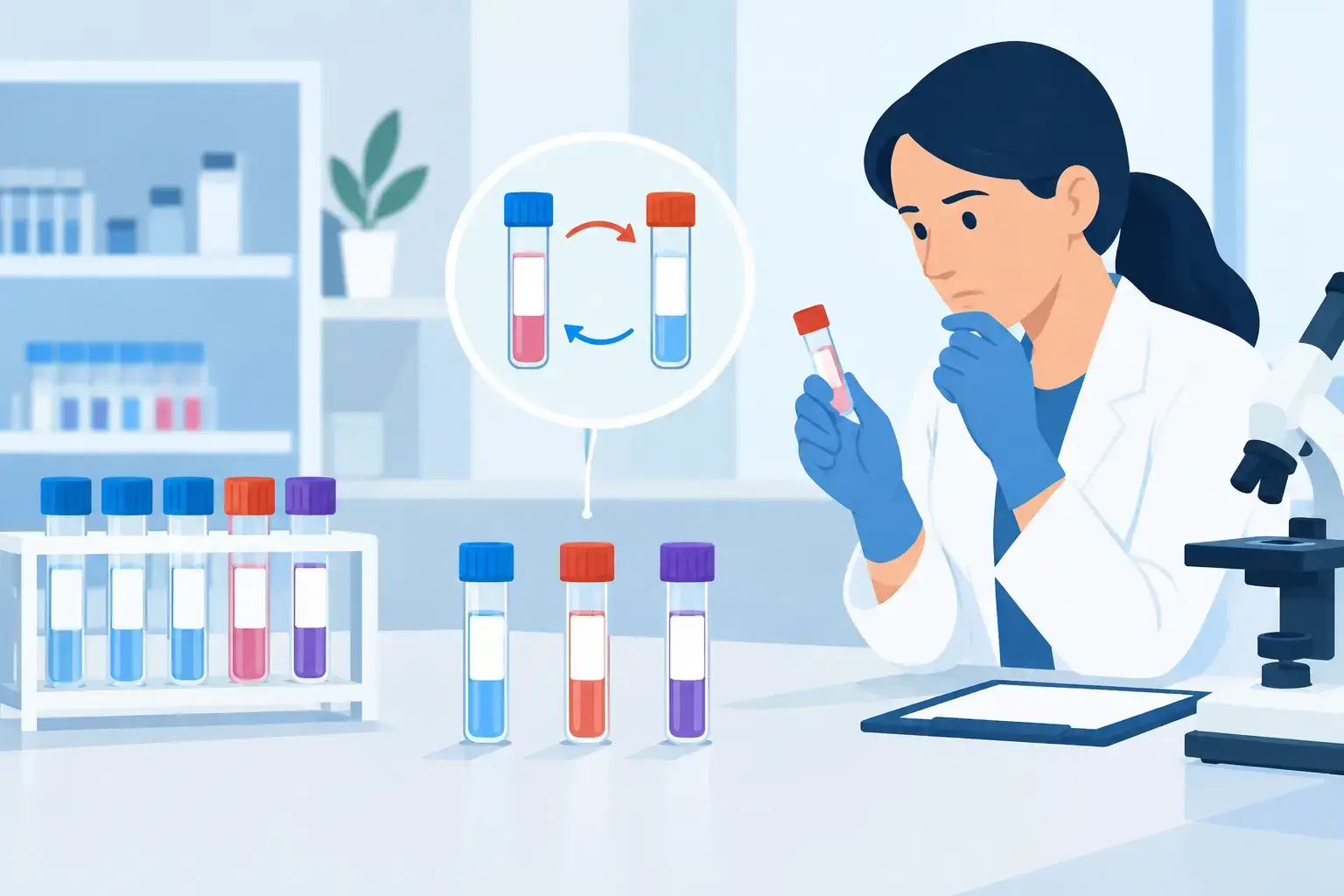
A sample can be scientifically valid and still become unusable if its identity cannot be trusted. When teams ask what causes sample mislabeling, the answer is rarely a single careless action. Mislabeling is usually the visible result of a workflow gap: an unclear handoff, a duplicate identifier, a label that cannot survive storage, or a record that was updated in one place but not another.
For research, clinical, biobank, and quality-controlled laboratory operations, sample mislabeling compromises more than a single test result. It can invalidate experimental conclusions, delay releases, require recollection, create compliance findings, and weaken confidence in the laboratory's chain of custody. Preventing it requires control over the complete sample lifecycle, from accessioning through processing, storage, retrieval, and disposal.
What Causes Sample Mislabeling?
Sample mislabeling occurs when the physical specimen, its container, and its associated record no longer represent the same identity. The error may involve the wrong patient or donor, the wrong experiment, an incorrect aliquot number, an inaccurate collection time, or an incorrect storage location. In some cases, the label itself is accurate but is applied to the wrong tube. In others, the tube is correct but its digital record has been edited, duplicated, or linked to the wrong parent sample.
The distinction matters because the control required depends on where identity was lost. A laboratory cannot correct an accessioning problem with better freezer organization alone, just as it cannot solve a post-analysis data association error solely by printing clearer labels.
Manual transcription and repetitive data entry
Manual transcription is one of the most common sources of identification error. Staff may copy a sample ID from a paper requisition to a tube, from a tube to a worksheet, and later from a worksheet into a spreadsheet or instrument interface. Every transfer creates an opportunity for a transposed digit, omitted character, or incorrect selection from a similar-looking list.
The risk increases when identifiers are long, handwritten, or only partly unique. A label such as “Control 1” may be meaningful at the bench during a single run, but it is not a durable identifier once samples are transferred, aliquoted, or stored with materials from other studies. Local shorthand is useful only when it remains linked to a controlled primary identifier.
Similar samples, containers, and naming conventions
Laboratories often process samples that look alike: clear tubes containing colorless liquid, tissue cassettes from adjacent cases, plates with repeated layouts, or batches collected from the same study cohort. Visual similarity can cause an operator to pick up, label, or move the wrong container even when the intended procedure is followed.
Naming conventions can make this worse. IDs that differ by one character, such as S-10458 and S-10548, are difficult to distinguish under time pressure. Ambiguous date formats, reused sample names, and study codes with overlapping abbreviations also introduce avoidable ambiguity. Good identifiers are unique, persistent, and designed to be read by both people and systems.
Interrupted workflows and uncontrolled handoffs
A sample's identity is most vulnerable when custody changes. This includes receiving specimens from a courier, transferring a plate between teams, moving material from a biosafety cabinet to a centrifuge, or placing aliquots into long-term storage. If the receiving person cannot confirm what was transferred, where it came from, and what happened to it, the chain of custody is incomplete.
Interruptions create similar risks. A phone call, instrument alarm, urgent request, or shift change can leave an operator with multiple open containers and an incomplete labeling task. The problem is not simply distraction. It is the absence of a workflow that makes the correct next action obvious and documents work in progress.
Labels that fail in real laboratory conditions
A barcode does not prevent mislabeling if it falls off, smears, cannot be scanned, or is applied over critical human-readable information. Cryogenic storage, solvents, moisture, repeated freeze-thaw cycles, centrifugation, and small tube diameters all affect label performance.
Label design must account for the sample environment. The printed identifier, barcode symbology, label material, adhesive, printer resolution, and scanner capability should be validated for the actual containers and storage conditions used by the laboratory. A label that performs well on a benchtop may fail after months in a freezer.
Aliquoting, pooling, and derivative creation
Identity control becomes more complex when one parent sample produces multiple child samples. Aliquots, extracted nucleic acids, cultured isolates, prepared libraries, and pooled materials all require explicit relationships in the record. A tube labeled only with the original sample ID may not distinguish aliquot A from aliquot B, or an extracted derivative from the source specimen.
Pooling introduces an additional traceability requirement. The laboratory must be able to identify every contributing sample, the pool identifier, the processing event, and the resulting downstream materials. Without this lineage, a mislabeled or compromised contributor can be difficult to investigate and impossible to isolate reliably.
Why Mislabeling Persists Despite SOPs
Most laboratories have procedures requiring labels, second checks, and documentation. Errors persist when those controls are impractical at the point of work or depend entirely on memory. A procedure may require immediate labeling, for example, but provide no way to generate a label beside the instrument. Staff then create temporary handwritten labels and plan to reconcile them later, moving risk into the busiest part of the workflow.
Paper logs and disconnected spreadsheets can also hide discrepancies. If a technician records an aliquot in one worksheet, a freezer location in another, and an experiment result in a separate file, no system is actively checking whether the records refer to the same material. The apparent problem may surface only when a sample cannot be found, an unexpected result requires investigation, or an audit asks for a complete history.
Training remains necessary, but training alone is not a control strategy. Well-trained people can still work under time pressure, fatigue, competing priorities, and inconsistent local practices. Effective systems are designed to make the correct action easier than the incorrect one.
Controls That Reduce Sample Identification Errors
The most effective prevention approach combines clear procedures with system-enforced traceability. At accessioning, the laboratory should assign a unique identifier that follows the specimen throughout its lifecycle. This identifier should be captured once, verified against the source documentation, and used to generate labels rather than rewritten manually.
Barcode-based workflows reduce repetitive transcription, but scanning should occur at meaningful control points. Scanning a sample when it is received, aliquoted, placed in a rack, moved to a freezer position, and retrieved for testing creates a time-stamped chain of custody. The value comes from the association between the scan, the user, the location, and the workflow event - not from the barcode alone.
A LIMS can enforce these relationships by maintaining parent-child sample lineage, controlled status changes, storage maps, user permissions, and audit trails. It can also prevent duplicate IDs, require mandatory metadata, and flag actions that do not match the expected workflow. For example, a user should not be able to assign an aliquot to a nonexistent parent sample or close a receiving event without essential identification data.
Laboratories should also standardize how labels are printed and verified. Where risk justifies it, two-person verification or an electronic positive-match check can be used for initial accessioning, critical transfers, and high-consequence samples. The appropriate level of verification depends on the sample type, regulatory requirements, batch size, and consequence of an incorrect result. Applying a second check to every low-risk activity may slow throughput without addressing the highest-risk points.
Designing a Traceable Sample Workflow
A controlled workflow begins by defining the sample states that matter operationally: received, quarantined, accepted, processed, aliquoted, tested, stored, consumed, and disposed. Each state should have clear entry criteria, responsible roles, and required data. This gives staff a consistent operational model and gives quality teams a basis for reviewing exceptions.
The workflow should also define what happens when identity is uncertain. Quarantine is not a failure; it is a control. A sample with an unreadable label, inconsistent paperwork, or unclear handoff should be segregated and investigated before it enters downstream testing. Attempts to “fix” an uncertain identity from memory create a larger data integrity problem.
LabCollector can support this model by centralizing sample records, barcode events, storage positions, inventory relationships, and experimental documentation in one controlled environment. When physical movements and digital records are managed together, laboratories have fewer opportunities for a sample to become disconnected from its history.
The practical goal is not to eliminate every human action. It is to ensure that each action preserves identity, produces an auditable record, and makes discrepancies visible while they can still be resolved. A laboratory that treats sample identification as a continuous workflow control protects both the specimen and the scientific decisions built on it.
See LabCollector on Your Own Workflows
LIMS, ELN, test management, storage and instrument integration on one platform — start free, or have us walk you through it.
Learn more: LabCollector LIMS · Electronic Lab Notebook · Contact · About
 English
 French
 Spanish
 Portuguese
 Italian
 Polish
 German
 Dutch
 Danish
 Swedish
 Greek
 Norwegian
 Finnish
 Romanian
 Hungarian
 Czech
 Slovak
 Hebrew
 Arabic
 Japanese
 Korean
 Ukrainian
 Latvian
 Turkish
 Croatian
 Chinese (Simplified)
 Bulgarian