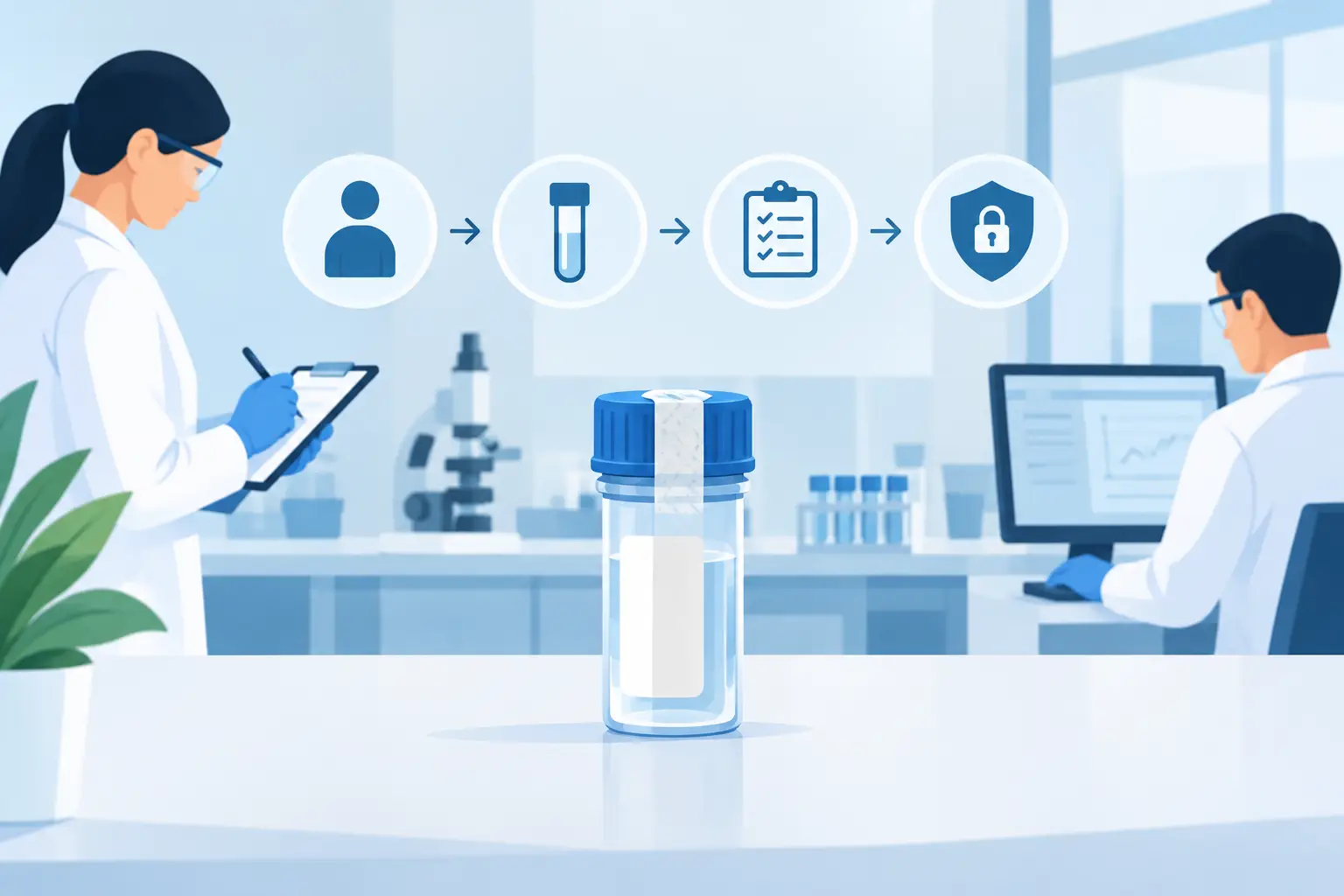
A sample label can remain readable while the sample’s history becomes unusable. If a tube changes hands, moves to a new freezer, is aliquoted, or is prepared on an instrument without a reliable record of who performed each action and when, the laboratory may no longer be able to defend the result. That is why laboratories need chain custody controls: they establish a documented, time-stamped account of a sample or material from receipt through storage, processing, analysis, and disposition.
For regulated laboratories, this record may be essential to meeting quality and legal requirements. For research laboratories, it is equally central to reproducibility, data integrity, and operational control. Chain of custody is not simply a signature on a paper form. It is a workflow discipline that connects physical materials, digital records, personnel, instruments, and decisions.
What Chain of Custody Means in a Laboratory
Chain of custody is the chronological documentation of possession, handling, location, and status changes for an item. In laboratories, that item may be a patient specimen, forensic sample, manufacturing batch, environmental sample, biological specimen, reagent, reference standard, or derivative such as an aliquot, extract, library, or prepared slide.
A complete record answers practical questions without relying on memory: Who received the material? When was it accepted? Under what conditions? Where was it stored? Who removed it? What process was performed? Which instrument, reagent lot, protocol version, and operator were involved? What happened to the remaining material?
The required level of detail depends on the laboratory's purpose and risk profile. A forensic laboratory may require formal transfer acknowledgments and tamper-evident controls. A discovery research group may place greater emphasis on linking sample lineage to experimental records. Clinical, quality control, and contract laboratories often need both operational traceability and controlled audit evidence. The common requirement is that the record is attributable, contemporaneous, and difficult to alter without visibility.
Why Laboratories Need Chain of Custody Beyond Compliance
Compliance is often the most visible reason to implement chain of custody, but it is not the only reason. Laboratories lose time and confidence whenever personnel must reconstruct events from paper logs, email threads, spreadsheets, freezer maps, and verbal recollections.
Sample integrity depends on documented handling
Many materials are sensitive to time, temperature, light, freeze-thaw cycles, contamination risk, or storage conditions. A custody record does not prevent every handling error, but it makes handling conditions visible and supports rapid investigation when results are unexpected.
Consider a plasma sample that produces an outlying assay result. If the laboratory can confirm its receipt time, storage location, transfers, thaw events, preparation steps, and analyst, the investigation can focus on relevant variables. Without that history, the result may be questioned, the sample may need to be recollected, and downstream decisions may be delayed.
Traceability protects result credibility
A test result is only as credible as the laboratory's ability to connect it to the correct source material. Misidentification can occur at collection, accessioning, aliquoting, plate setup, instrument loading, or report review. Chain of custody creates the evidence needed to show that the reported result belongs to the intended sample.
This is particularly important when samples generate multiple derivatives. A parent specimen may produce several aliquots, nucleic acid extracts, amplified products, sequencing libraries, or retained samples. The laboratory must preserve lineage between each derivative and its parent while recording the process that created it. A simple location history is not sufficient.
Audit readiness becomes an operating condition
When records are fragmented, preparing for an internal review, sponsor audit, accreditation assessment, or regulatory inspection becomes a document-retrieval exercise. Staff must assemble evidence after the fact, often under time pressure. A structured chain of custody makes the relevant evidence part of routine work.
This does not mean every laboratory needs the same controls. Overly burdensome logging can cause users to work around the system, creating a false appearance of control. The appropriate design captures critical events at the point of work while using automation, barcode scans, and defined workflows to reduce manual entry.
Investigations can be completed with facts
Deviations, discrepancies, sample loss, and failed runs require an evidence-based response. Chain of custody provides an event history that helps the laboratory determine scope and impact. It can show whether an issue is isolated to one sample, one storage unit, one operator, one reagent lot, or one workflow step.
That distinction matters. Without traceable events, laboratories may repeat entire batches or quarantine materials unnecessarily. With reliable history, quality teams can make targeted decisions, document corrective action, and preserve unaffected work.
The Events a Defensible Custody Record Should Capture
A chain of custody process should map to the laboratory's actual workflow rather than forcing generic fields onto every item. Still, most laboratories need to capture four categories of information: identification, custody, condition, and transformation.
Identification begins with a unique sample or material ID that remains linked to labels, containers, and electronic records. Barcodes reduce transcription errors and allow staff to verify identity during receipt, movement, processing, and inventory transactions.
Custody records the person or authorized system responsible for an action, along with date and time. A transfer between staff members is only one custody event. A move from a receipt area to controlled storage, removal from a freezer, placement on a workbench, and return to storage can all be relevant, depending on the material and workflow.
Condition captures the context that can affect usability, such as receipt condition, storage temperature range, container status, expiration, hold status, or deviation flags. Transformation documents how a sample changed, including aliquoting, pooling, extraction, dilution, preparation, destruction, or disposal. These events must preserve parent-child relationships so that the full lineage remains available.
Digital Chain of Custody Reduces Gaps Between Teams
Paper logs can provide evidence, but they create practical limits. Handwriting may be unclear, logs may be stored separately from sample records, and paper cannot easily validate whether a scanned barcode matches the expected location or workflow stage. Spreadsheets improve searchability but often lack controlled permissions, immutable audit history, and reliable links between inventory, experiments, and instrument outputs.
A laboratory information management system can centralize those activities. When sample registration, barcoding, storage mapping, workflow status, and audit trails operate in the same system, the laboratory can record custody events as work occurs. Role-based access controls help ensure that only authorized users can perform or approve defined actions, while audit trails retain visibility into changes.
An electronic lab notebook adds another layer of context. It can connect a sample's custody and lineage record to the protocol used, experimental observations, calculations, and attached data files. Instrument integration and automation can further reduce manual transcription by associating run information with the samples processed.
LabCollector supports this type of connected environment by bringing LIMS, ELN, inventory, storage, barcode, equipment, and reporting functions into a configurable laboratory platform. The objective is not to collect more data for its own sake. It is to make the data required for traceability available where laboratory decisions are made.
Designing Controls That Staff Will Use
The strongest chain of custody process is one that fits daily laboratory operations. Begin by identifying the materials and events that create the highest risk. High-value specimens, regulated materials, samples with limited volume, and items that pass across departments usually require more formal controls than low-risk consumables.
Then define ownership at each handoff. A workflow should make clear when responsibility changes, what verification is required, and what happens when a discrepancy is found. For example, receiving personnel may verify shipment contents and condition, while analysts confirm identity before preparation and storage personnel confirm placement in the assigned location.
Configuration should also account for exceptions. Samples arrive damaged. Labels do not scan. Freezers alarm. A sample may be temporarily relocated during maintenance. If the system only supports the ideal path, staff will document exceptions outside it. Controlled exception statuses, reason codes, and review steps keep unusual events within the record.
Training matters, but it should focus on the operational reason behind each step. Personnel are more likely to scan a container, confirm a transfer, or record a disposition when they understand that the action protects sample identity, result credibility, and the work of colleagues downstream.
Chain of Custody Is a Foundation for Controlled Science
Laboratories do not implement chain of custody merely to satisfy an auditor or create a longer record. They implement it because scientific and operational decisions depend on knowing what happened to a material before a result was produced. When custody, location, lineage, and handling history are visible in one controlled record, teams can investigate faster, release results with greater confidence, and protect the value of every sample entrusted to the laboratory.
See LabCollector on Your Own Workflows
LIMS, ELN, test management, storage and instrument integration on one platform — start free, or have us walk you through it.
Learn more: LabCollector LIMS · Electronic Lab Notebook · Contact · About
 English
 French
 Spanish
 Portuguese
 Italian
 Polish
 German
 Dutch
 Danish
 Swedish
 Greek
 Norwegian
 Finnish
 Romanian
 Hungarian
 Czech
 Slovak
 Hebrew
 Arabic
 Japanese
 Korean
 Ukrainian
 Latvian
 Turkish
 Croatian
 Chinese (Simplified)
 Bulgarian